Floral Pregnancy Line Art SVG
A Designer’s First Glance: Delicate, Warm, and Quietly Confident
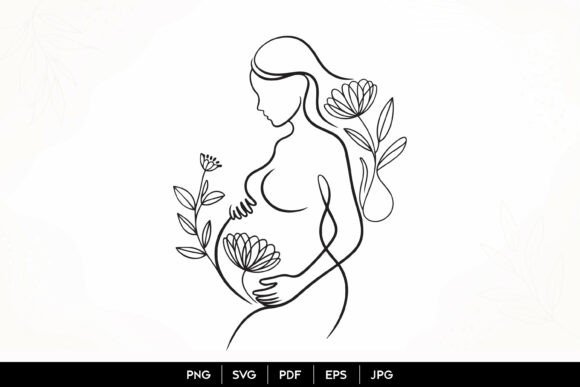
When I opened Floral Pregnancy Line Art SVG, I didn’t see just another maternity illustration—I saw a mood. Soft curves, minimal linework, and subtle botanical flourishes wrap gently around the silhouette of an expecting mother. It’s not fussy or overly detailed; it’s intentional. The line weight stays consistent, the negative space breathes, and the floral accents feel like quiet companions—not decorations. That tells me this isn’t meant for loud statement pieces, but for thoughtful handmade products: a linen tea towel for a baby shower gift, a relaxed-fit sweatshirt for a mama-to-be’s first trimester, or a minimalist embroidered patch on a denim jacket. It leans into tenderness without tipping into sentimentality—and that balance matters.
How It Stitches: Clean Lines, Clear Readability, Few Surprises
I tested Floral Pregnancy Line Art SVG as a machine embroidery design on midweight cotton twill (for a custom tote bag) and 100% cotton jersey (for a soft baby onesie). On both, the line art translated cleanly—no jagged breaks, no unintended overlaps. Because it’s built as clean vector line art—not dense fill stitch or heavy satin borders—it avoids common pitfalls: thread nesting, excessive stitch density, or stabilizer show-through on light fabrics. That makes it especially reliable for small-batch craft business owners who don’t want to re-hoop three times per piece.
It works beautifully as a running stitch or single-outline satin stitch—ideal for delicate embroidery projects where subtlety is part of the appeal. I wouldn’t recommend converting it to a heavy fill-stitch applique unless you intentionally want to soften its character. As-is, it reads clearly at 3–4 inches wide, which fits perfectly on a tote bag front, pillow cover corner, or apron pocket.
Where It Shines—and Where to Pause
Floral Pregnancy Line Art SVG feels most authentic on natural-fiber, low-sheen textiles: organic cotton tees, unbleached linen napkins, oatmeal-colored sweatshirts, and woven baby blankets. Its gentle rhythm matches the texture and tone of those materials. On dark fabric? It holds up well—if you use high-contrast thread (ecru on navy, charcoal on cream). On stretchy knits? Use a light cutaway stabilizer and reduce top tension slightly; the continuous line flow helps prevent puckering.
That said—skip it for tiny hoops under 3 inches. Some of the finer floral stems and inner contour lines shrink into ambiguity below that size. Also avoid curved surfaces like structured caps unless you’re experienced with digitizing adjustments; the smooth silhouette doesn’t adapt well to severe distortion without manual cleanup. And while it’s lovely on tea towels and nursery pillows, don’t push it onto heavily textured fabrics like bouclé or thick terry cloth—the line detail gets lost.
Real Project in Action: A Boutique Sweatshirt Launch
Last month, I used Floral Pregnancy Line Art SVG to embroider a limited run of oversized oatmeal sweatshirts for a local boutique’s “Motherhood Edit” collection. We stitched it centered on the chest in matte charcoal thread—no fill, just a crisp running stitch outline. Customers responded immediately: “It’s so *us*,” one told me. “Not cutesy, not clinical—just real.” That’s the quiet strength of this design. It supports the product instead of shouting over it. It elevated the sweatshirt from casual apparel to a keepsake-level personalized gift—without needing extra embellishment.
What It Does for Your Craft Business
For Etsy sellers and small shop owners, Floral Pregnancy Line Art SVG adds quiet professionalism to your listings. It signals care—not just in execution, but in intention. When paired with clean printable mockups (using the included PNG and PDF files), it communicates brand cohesion before the buyer even sees the physical item. And because it’s offered across SVG, EPS, JPG, PNG, and PDF formats, it’s flexible: use the SVG for embroidery digitizing, the PNG for social media banners, the PDF for print-on-demand packaging inserts.
It also builds trust. Buyers recognize when a design respects the subject matter—here, pregnancy as a grounded, graceful experience—not a cartoon or cliché. That resonance increases perceived value, repeat engagement, and word-of-mouth referrals among thoughtful gift-givers and expecting parents.
Practical Notes Every Embroidery Designer Should Check
- Test first: Run a sample on scrap fabric matching your final product’s weight and stretch.
- Review thread color contrast: This design relies on clarity—not coverage—so mismatched thread can mute its impact.
- Confirm hoop size compatibility: Aim for at least a 4" x 4" hoop to preserve line integrity.
- Inspect small details: Zoom in on floral tips and inner contours—some vectors may need minor smoothing before digitizing.
- Mock it in black and white: Helps spot unintended visual weight shifts on light vs. dark backgrounds.
- Stabilizer choice matters: Use tear-away for stable wovens, light cutaway for knits or lightweight linens.
- Licensing check: Since this is sold as a digital embroidery file and Illustrations/Graphics asset, verify usage rights before selling finished embroidered goods or bundling it into commercial design assets.
Final Thought: A Design That Listens
Good embroidery design doesn’t just look right—it behaves right. Floral Pregnancy Line Art SVG behaves with restraint, clarity, and warmth. It doesn’t demand attention; it invites connection. Whether you’re stitching a one-off baby milestone pillow or building a cohesive maternity-themed product line, this design supports your voice instead of overriding it. It’s not flashy—but then again, the most meaningful handmade products rarely are.