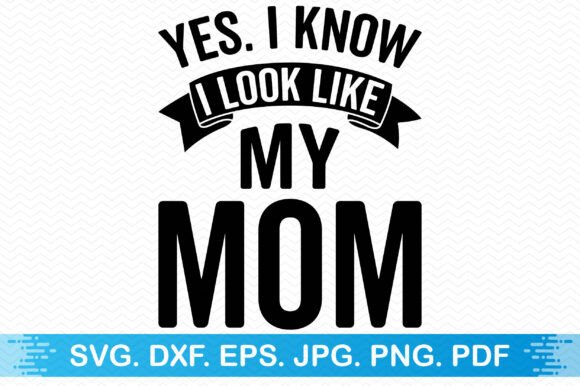
Yes I Know I Look Like My Mom Clipart
A Designer’s First Glance: Charm, Clarity, and Quiet Confidence
When I opened the Yes I Know I Look Like My Mom Clipart folder for the first time, I wasn’t scanning for pixels—I was feeling for personality. The design lands with gentle humor and warm sincerity: clean lines, balanced proportions, and a subtle nod to generational affection without tipping into cliché. It’s not overly cutesy or cartoonish—there’s a quiet confidence in its simplicity that makes it feel like something you’d actually stitch on a gift you’re proud to give. As an embroidery designer who’s tested hundreds of graphics for real-world wear, I immediately pictured this on a soft cotton tote bag for Mother’s Day—something sturdy enough for farmers’ markets but thoughtful enough to hang in a kitchen as decor.
Where This Design Truly Shines
Yes I Know I Look Like My Mom Clipart works best where authenticity and emotional resonance matter more than flash. Think embroidered baby onesies (paired with a tiny heart or floral accent), relaxed-fit sweatshirts for mom-and-me matching sets, linen pillow covers for nursery shelves, or tea towels for a boutique kitchen line. Its open lettering and moderate detail level translate well into satin stitch outlines and light fill areas—no dense stitching that risks puckering on lightweight fabrics. As a machine embroidery design, it holds up beautifully at 3–4 inches wide on stable cotton blends, and the clean vector foundation (SVG included) gives flexibility if you need to scale slightly for caps or patches.
I recently tested a mockup on a midweight unbrushed cotton apron—no lining, no heavy stabilizer—and the result felt handmade, not mass-produced. That’s key for Etsy sellers and small shop owners: customers notice when stitching breathes naturally, and this design supports that. It also reads clearly in printable mockups, which helps craft business owners present cohesive listings without over-editing.
Use With Intention—Not Just Convenience
This isn’t a one-size-fits-all embroidery file. Its charm depends on context. On stretchy fabric like jersey tees? Proceed carefully—tighten your hoop, use cutaway stabilizer, and consider simplifying the text outline if thread tension wobbles. On dark fabric? Test contrast early: light thread can fade visually unless you add a subtle underlay or choose matte poly for richness. And while the SVG is Cricut-ready, remember this is primarily a graphics asset—not a pre-digitized embroidery file. If you’re sourcing for commercial embroidery, confirm whether digitizing is included or if you’ll need to partner with a digitizer for optimal stitch density and jump-thread management.
Small hoop sizes (under 4” x 4”) will require trimming or repositioning—some curves and spacing assume breathing room. And avoid cramming it onto curved surfaces like structured caps without testing placement first; the symmetry matters, and distortion kills the warmth.
Real-World Fit for Real Products
- Tote bag design: Excellent—clean silhouette reads from a distance, stitches hold up through daily use.
- Sweatshirt embroidery: Strong on brushed fleece if stabilized properly; avoid high-pile textures that swallow fine lines.
- Baby embroidery: Ideal for onesies and burp cloths—soft edges prevent scratchiness, and the theme resonates with new parents.
- Holiday embroidery: Works beautifully on Christmas stockings or Easter egg towels—nostalgic but not seasonal-specific.
- Embroidered patch: Clean enough for iron-on backing; just reinforce satin-stitch borders with a tight running stitch outline.
What It Adds to Your Handmade Product—and What It Doesn’t
This design elevates perceived value because it feels personal—not generic. When customers see Yes I Know I Look Like My Mom Clipart stitched cleanly on a linen market bag, they don’t think “clipart.” They think “someone chose this *for me*.” That builds trust. It supports brand consistency for shops centered on family, nostalgia, or slow-made values. But it won’t carry weak execution: poor thread choice, uneven tension, or rushed hooping will expose its simplicity rather than enhance it.
For digital product sellers, it’s a versatile design asset—easy to pair with coordinating florals or monograms in listings. Just double-check licensing before bundling it into editable templates or resale packs. The description says it's delivered as SVG, PNG, EPS, PDF, JPG, and DXF—great for hybrid crafters—but again, confirm commercial rights directly with the seller if you plan to sell finished embroidered goods or resell the files themselves.
Practical Notes From the Hoop
- Always test Yes I Know I Look Like My Mom Clipart on scrap fabric first—especially if using textured or dark materials.
- Check thread color contrast in natural light *and* on camera—what looks bold on screen may mute on oatmeal linen.
- Review stitch density in your embroidery software: look for tight corners or overlapping fills that could cause buildup.
- Confirm hoop size compatibility—some versions may need slight scaling depending on your machine’s max dimensions.
- Inspect small details like serif ends or inner counters—if digitizing yourself, ensure those stay legible at your target size.
- Test black-and-white mockups to verify readability on both light and dark backgrounds.
- Use appropriate stabilizer: tear-away for stable wovens, cutaway for knits or delicate items.
- Remember: this is a T-Shirt Designs-category graphic, but its strength lies beyond t-shirts—lean into tote bags, baby items, and home goods where sentiment lingers longer than a single wear.
In short: Yes I Know I Look Like My Mom Clipart isn’t flashy—but it’s reliable, emotionally grounded, and quietly versatile. It rewards thoughtful execution and fits seamlessly into projects where care, connection, and craftsmanship are the real selling points.